
Plenty of clogs never need a professional — and we'd rather tell you which ones honestly than clear a hair clog for a service fee. The DIY drain arsenal has real winners and real trouble-makers. Here's the professional's honest review of the hardware-store shelf.
The genuinely effective
Zip strip (barbed plastic strip): the single best value in drain care — clears hair clogs from bathroom sink and shower pop-ups in seconds. Keep two. Cup plunger: correct tool for sinks and tubs, and technique matters more than force — seal the overflow with a wet rag, keep water over the cup, use sharp compact strokes. Flange plunger: the toilet-specific design; the fold-out flange seals the trapway where a cup plunger can't. Hand auger (25'): the graduation tool — effective on sink and tub branch clogs within its reach when fed patiently and cranked at resistance rather than forced.
Situational and overhyped
Closet auger: excellent for toilets — the sleeve protects porcelain — but only reaches the trapway; if the clog is past the toilet, it can't help. Wet/dry vacuum: genuinely useful for pulling a clog back toward you (especially objects) when sealed well against the drain. Drain bladders (hose-powered expanding bags): they work until they don't — in old or compromised pipe, pressurizing the line risks blowing apart a weak joint. Baking soda and vinegar: satisfying chemistry, freshens a drain, moves no real clog; useful as deodorizing maintenance only.
The make-it-worse list
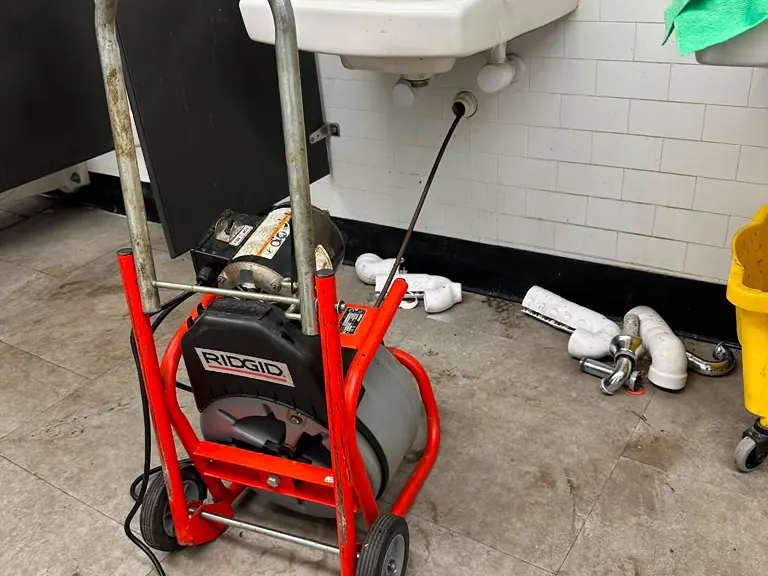
Chemical drain openers: rarely clear real blockages, corrode aging pipe, and leave the line hazardous for whoever opens it next (that's usually us — please mention it if you've used them). Coat hangers: compact the clog into a denser plug and scratch fixtures. Power drill + cheap drum auger in inexperienced hands: the cable can knot, kink, or whip inside the pipe — and retrieving a broken cable from a drain is a service call with a story attached. Pressure washers improvised into drains: genuinely dangerous without proper jetting nozzles and training.
The escalation rule
DIY when: one fixture, recent onset, plausible local cause (hair, food scraps, an object). Stop when: multiple fixtures are involved (main-line territory), the same clog returns within weeks (a physical cause needs diagnosis), sewage is involved, or you're eyeing the drain bladder and the pipe is older than you. The professional difference isn't muscle — it's matched equipment and knowing what the pipe can take. Lumin Drain NJ handles the clogs the zip strip can't, everywhere in New Jersey: 929-662-1816.