
Every heavy-rain season, the same story plays out in basements across New Jersey: the town's sewer main surcharges, and everything in it looks for the lowest opening — which is your floor drain. There is exactly one device that makes this physically impossible, and most of the homes that need it don't have it. Here's how a backwater valve works, who genuinely needs one, and what installation involves in NJ.
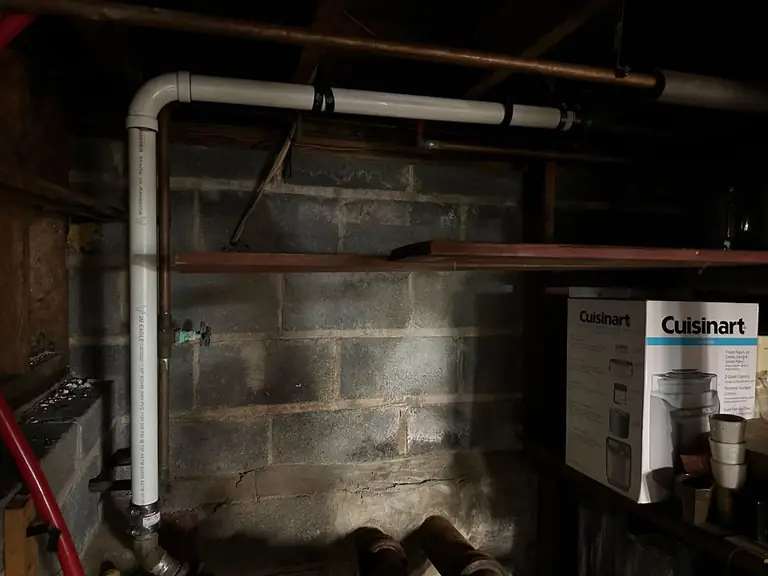
What a backwater valve actually does
A backwater valve (also called a backflow preventer or check valve for sewage) is a one-way gate installed on your sewer lateral. Wastewater flowing out of your house pushes the flap open and passes normally. Water trying to flow the wrong way — from the municipal main toward your house — pushes the flap shut and is physically blocked. No power, no sensors, no decision-making: pure gravity and geometry. When the town's system surcharges in a storm, the surge stops at the valve instead of rising out of your basement floor drain.
Who actually needs one in NJ
Three profiles account for most of the valves we install. First: any home with a finished basement in a town that surcharges during heavy rain — especially older municipalities in Hudson, Essex, Bergen, and Passaic counties where combined or aging sewers still carry stormwater. Second: homes that sit low relative to the street or the surrounding neighborhood, where the hydraulics make them the release point for everyone uphill. Third: anyone who has already had one municipal-side backup — because the conditions that caused it will recur. NJ's plumbing code has long required backflow protection where fixtures sit below the elevation of the next upstream manhole, which describes a large share of basement bathrooms and laundry rooms in this state.
What installation involves
The valve goes on the main building drain or lateral, downstream of all fixtures. In most NJ basements that means opening a small section of the slab near the front foundation wall, cutting the valve into the line, and finishing with an access box flush to the floor so the flap can be inspected and cleaned. Outdoor installation in the yard with a ground-level access sleeve is the alternative where slab access is poor. It's typically a one-day job. Expect a plumbing permit and inspection — every NJ municipality requires them for this work — and expect a camera inspection first, because the valve must go into sound pipe and because a lateral already choked with roots needs that fixed regardless.
What it costs — and what it saves
In New Jersey, a professionally installed backwater valve typically runs $1,500–$4,000 depending on slab depth, pipe material, and access; complicated exterior installs can run more. Set against the alternative — a finished-basement sewage backup routinely causes $10,000–$50,000 in damage, and standard homeowners insurance excludes backups by default — the valve is one of the highest-return purchases in home plumbing. Some insurers discount the water-backup endorsement when a valve is installed; a few NJ towns and utility authorities have periodically offered rebate programs for backflow protection in chronic-backup neighborhoods, so it's worth one call to your municipality before scheduling.
The honest limitations
A backwater valve blocks water coming from the street — it does nothing about a blockage in your own lateral, and while it's closed during a storm your own wastewater has nowhere to go, so you throttle water use for a few hours. It also needs a five-minute check twice a year to stay reliable. Pair the valve with a healthy, camera-verified lateral and (where groundwater is the threat) a working sump pump, and you've closed off every path water takes into an NJ basement from below.
Frequently asked questions
Can I use my plumbing while the backwater valve is closed?
You shouldn't. When the flap is closed against a surcharging main, everything you send down your own drains has nowhere to go and will back up behind the valve — inside your house. During the hours of a major storm event, minimize water use: hold laundry and dishwasher loads until the municipal system recovers. It's a small tax for a dry basement.
Does a backwater valve need maintenance?
Yes — that's the part sales pitches skip. Open the access cover once or twice a year, check that the flap moves freely, and rinse out any debris sitting in the body. A valve fouled open protects nothing; a valve fouled shut backs your own house up on a sunny day. Five minutes twice a year keeps it honest.
Will a backwater valve stop backups caused by my own clogged line?
No — and this matters. The valve blocks flow coming from the street toward your house. If your own lateral is blocked by roots or wipes downstream of your fixtures, your wastewater still backs up on your side. That's why we camera the line before installing: a valve on a root-choked lateral solves the wrong problem first.
Lumin Drain NJ cameras the line, pulls the permit, installs the valve, and shows you how to check it — anywhere in New Jersey. If your basement has flooded once, call 929-662-1816 before the next storm cycle does it again.