
Cast-iron drain pipe ages in a particular way: it doesn't just clog, it slowly closes, growing a rough interior lining of rust scale that narrows the bore and snags everything passing through. Descaling — mechanically stripping that lining back to sound metal — can restore decades of capacity. It can also be the wrong move for a pipe whose walls are mostly scale. Here's how to tell the difference.
What scale does to a working pipe
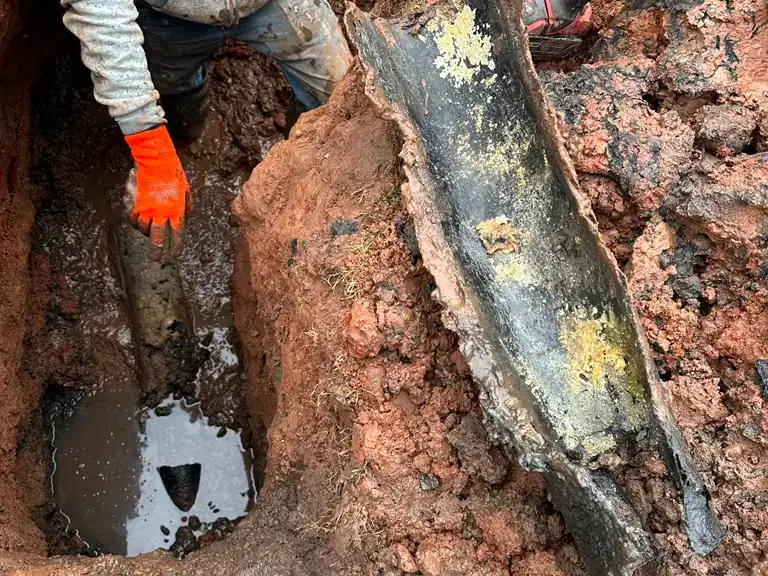
Iron oxidizes; in a drain, the oxidation builds inward as tubercles and ridges of scale. A 4-inch cast-iron line can lose a third to half its effective diameter over fifty years, and the rough surface catches paper, wipes, and grease that smooth pipe would pass — which is why aging cast iron generates recurring 'clogs' that are really symptoms of shrinking geometry. Snaking opens a channel through soft buildup but barely touches hardened scale.
How descaling actually works
Two mechanical approaches: chain knocking — flexible chains spun by a cable machine, flailing scale off the walls — and high-pressure jetting with rotary descaling nozzles that cut scale hydraulically. Both proceed section by section with camera verification, because the operator must see what's coming off and what's being revealed. Done properly, the pipe emerges at close to original bore with walls smooth enough to stop snagging debris. It's slower, more skilled work than routine cleaning, priced accordingly — and typically far below replacement cost for accessible runs.
The critical question: what's under the scale
Here's the honest catch: in far-gone pipe, the scale is partly structural — the walls have thinned, and the rust layer is filling gaps the iron no longer does. Descale that pipe aggressively and you graduate from restricted-pipe problems to holed-pipe problems. This is why the pre-descaling camera inspection isn't a formality: an experienced eye reads the scale pattern, existing cracks, channel rot along the bottom, and prior repairs, and judges whether the pipe is a restoration candidate or a replacement-in-denial. A contractor who quotes descaling sight-unseen is guessing with your building drain.
Where descaling wins, and where it doesn't
Strong candidates: mid-life cast iron with heavy scale but sound walls, under-slab runs where replacement means breaking floors, occupied buildings where excavation is disruptive, and pipe being prepared for lining (liners need clean walls to bond). Poor candidates: pipe with visible wall failure, channel rot, or crush damage — restoration money there merely delays and complicates the replacement. The good news: the same camera pass answers the question either way. Lumin Drain NJ inspects, descales, and — when the walls have earned it — replaces cast iron across New Jersey, with footage before and after: 929-662-1816.