Every homeowner who's paid to have roots cut out of a sewer line eventually stands in a hardware aisle holding a jug that promises to make the problem never return for twelve dollars. As the people who see inside these pipes before and after, here's the honest review of what root-killing chemistry can and cannot do.
The two chemistries
Copper sulfate crystals: flushed down the toilet, they dissolve and poison root tissue on contact as water carries them through the line. The physics is the problem — crystals travel along the pipe's bottom in the water flow, while roots enter mostly from the top and sides of joints, hanging above the flow. Contact is partial at best. Foaming herbicides (metam-sodium or dichlobenil formulations): applied as a foam that fills the pipe's full diameter, contacting roots wherever they hang. Meaningfully better contact, meaningfully better results — and more product cost and application care.
What they genuinely accomplish
On fine, recently cut root regrowth, a properly applied foaming treatment genuinely slows the return — extending the interval between mechanical cleanings, sometimes substantially. That's the honest ceiling: maintenance-interval extension. What no chemical does: remove the established root mass (dead roots don't dissolve; the woody mass remains as a debris net until mechanically cut), repair the joint or crack the roots entered through, or affect the tree's decision to send the next root to the same reliable water source.
The correct sequence, if you use them
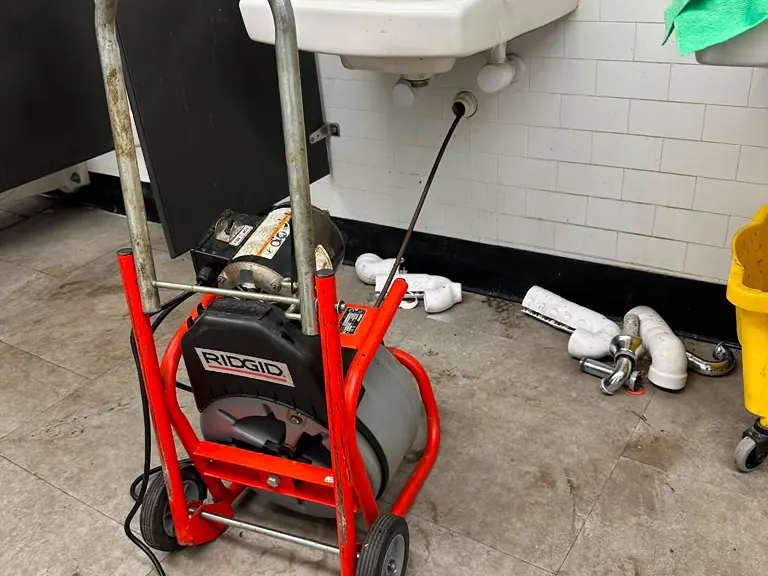
Chemicals only make sense after mechanical clearing: cut the mass out first (cable or jetting), then treat the freshly cut stubs while they're vulnerable, then re-treat on the product's schedule. Treating an intact root mass wastes the product against tissue that's mostly not in contact. Cautions: follow labels exactly — copper sulfate is restricted in some municipalities and unfriendly to septic biology; never use root chemicals in lines feeding a septic tank without confirming compatibility; and keep expectations at 'slower regrowth,' not 'problem solved.'
Where they fit in a real plan
Root intrusion is a structural problem wearing a vegetation costume — roots are in the pipe because openings exist. The permanent fixes seal the openings: spot repair of the failed joints, lining, or replacement. Chemical maintenance fits homeowners deliberately deferring that repair: clear mechanically, treat chemically, budget for the real fix, and camera-inspect periodically to watch the openings' progression. As a substitute for repair, root killer is a subscription to a slowly worsening problem. Lumin Drain NJ provides root clearing, camera diagnosis, and the permanent repairs across New Jersey — with honest advice about which stage your line is in: 929-662-1816.