
The mature oaks and maples lining New Jersey's streets are also the region's most persistent plumbing adversary. Roots don't smash through pipes like something out of a movie — they exploit them, patiently and hydraulically. Understanding how intrusion actually works explains why some fixes last twenty years and others barely last a season.
How roots find your pipe
A sewer lateral is warm, wet, and nutrient-rich — everything a root system wants. Vapor escaping from tiny gaps at pipe joints creates a moisture gradient in the soil, and roots follow it with remarkable precision. The root doesn't break the pipe to get in; it finds an existing gap — a clay joint, a hairline crack, a slightly separated coupling — and sends in a tendril finer than a hair.
From tendril to blockage
Inside the pipe, that tendril has unlimited water and food. It thickens and branches into a root mat that catches paper, wipes, and grease like a net. Worse, as the root grows in diameter inside the joint it entered, it acts as a hydraulic jack — slowly prying the joint apart, cracking the pipe, and opening the door wider for the next root. Intrusion is self-accelerating.
Why clay pipe is the prime target
Vitrified clay laterals, standard in the region for decades, were installed in short sections with a joint every few feet. Each joint is a potential entry point, and after 60–100 years of soil movement, most have shifted at least slightly. Cast iron resists roots better until corrosion opens cracks; modern PVC, with long sections and sealed gasketed joints, is effectively root-proof when properly installed.
Fixes that don't last vs. fixes that do
Cutting roots with a cable or jetting nozzle restores flow — but it's pruning, and pruned roots regrow, often denser. As a maintenance strategy it works if you accept a recurring schedule. Foaming herbicides can slow regrowth but don't repair the openings roots entered through.
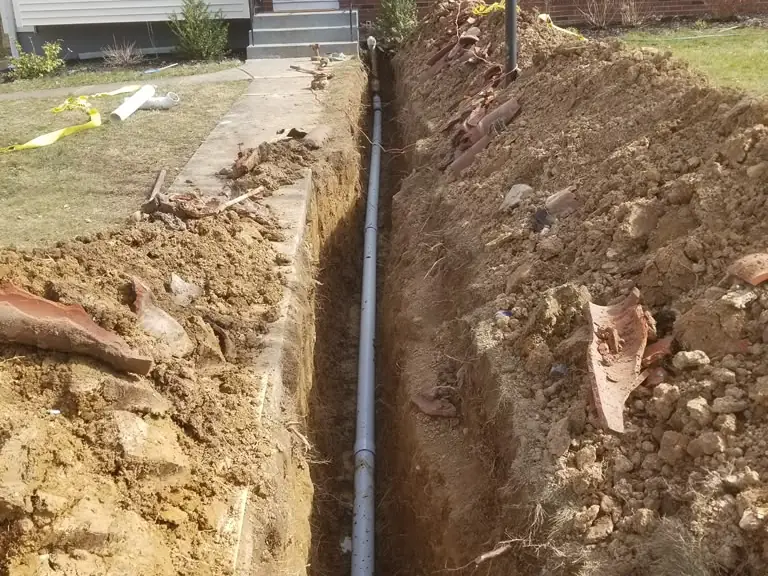
Permanent solutions target the entry points: a spot repair replacing the failed joint, structural lining that seals the pipe's interior, or full lateral replacement with gasketed PVC. A camera inspection with surface locating tells you exactly how many entry points exist — which determines whether a $1,500 spot repair or a full replacement is the right call.
The smart sequence
Restore flow first, then diagnose, then decide: clear the roots, camera the line, count the intrusion points, and match the fix to the evidence. Lumin Drain NJ handles every step — root clearing, HD inspection, and permanent repairs — throughout New Jersey. Call 929-662-1816 before the roots make the decision for you.