
Every sewer lateral in New Jersey is on a clock, and the countdown started the year it was installed. Knowing the material under your lawn — and its realistic service life — turns sewer planning from a panicked emergency into a scheduled decision. Here's the field guide, based on what our cameras see every week.
Vitrified clay: 50–100+ years, joints permitting
Clay pipe itself is remarkably durable — it doesn't rust and resists chemical attack. Its weakness has always been the joints: short pipe sections mean joints every few feet, and each is an entry point for roots and a hinge for soil movement. A clay lateral's life is really the life of its joints. Well-bedded clay in root-free soil can pass 100 years; clay under mature trees often needs help by 60.
Cast iron: 50–75 years, corroding from inside
Cast iron is strong and quiet, but it corrodes from the inside out. Channel rot along the pipe's bottom — where water flows constantly — thins the wall until it cracks or collapses, while internal scale narrows the bore and snags debris. Homes from the 1940s–70s with original cast iron are in the material's endgame; a camera inspection reveals how much wall is actually left.
Orangeburg: 30–50 years, and the clock has expired
Bituminized wood-fiber pipe — essentially tar-impregnated paper — was installed widely mid-century when metal went to the war effort and stayed popular into the 1970s. It deforms under soil load, blisters internally, and collapses in its later decades. Every Orangeburg lateral still in service is past its design life. If your home dates to that era and the lateral has never been replaced, an inspection isn't optional — it's overdue.
PVC: 100+ years projected
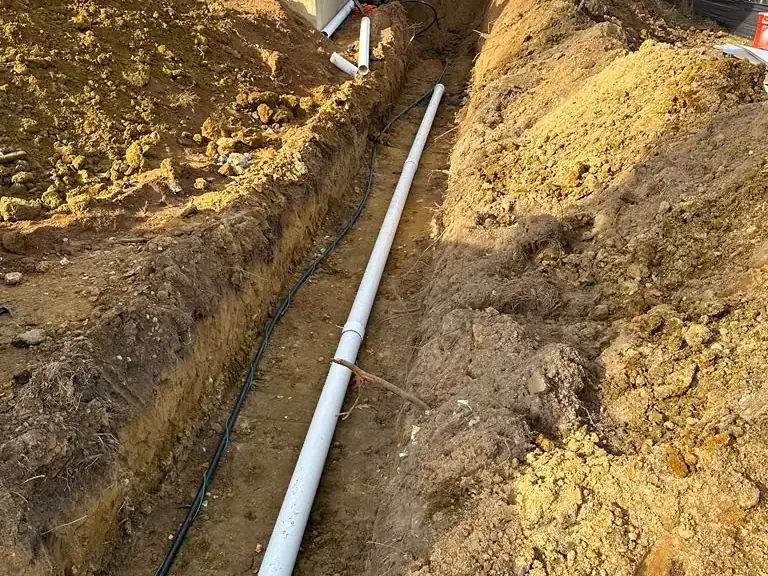
Modern PVC laterals use long sections with gasketed or solvent-welded joints — few entry points, no corrosion, smooth interior walls. Properly bedded and sloped, PVC is expected to outlast the homes it serves. This is what every replacement we install becomes.
How to find out what you have
Your home's construction year is a strong hint, but renovations, partial repairs, and material transitions (clay to cast iron at the foundation is common) mean the only certainty is looking inside. A camera inspection identifies the material, measures the condition, and locates any transitions — giving you a factual basis for whether your lateral needs monitoring, maintenance, or a place in next year's budget. Lumin Drain NJ scopes laterals across New Jersey with recorded footage you keep: 929-662-1816.